An encrypted notes app your AI can use
Pinto Notes encrypts every note on your iPhone or Mac before it syncs, and ChatGPT and Claude can still read and edit them once you approve. Those two things pull against each other, so here's exactly how it works, what it doesn't protect, and how other notes apps handle the same trade-off.
What's encrypted
Your notes, their titles, folder names, file names and files, and every earlier version are encrypted on your device before they're uploaded. The key is made on your first device, or in your browser if you sign up on our website. We store the encrypted copies, in Frankfurt.
We keep a locked copy of your key so that signing in opens your notes on a new device, with no other device and no recovery key. That means we could open your notes if we had to, for example under a court order, and so could someone who gets into your account. The copy is sealed with a secret that isn't in the database, so the sealed copy can't be opened with the database alone, but we hold both.
Advanced protection, which deleted our copy and kept the key on your devices only, is being retired. Newer apps don't offer it. Accounts that have Advanced protection on keep it until they turn it off; for them we can't open the notes and can't help them back in. If your account is from before we kept copies, the app asks you once, and nothing is copied until you answer.

- A recovery key opens your notes without us, if you saved one. Newer apps show it only while Advanced protection is on.
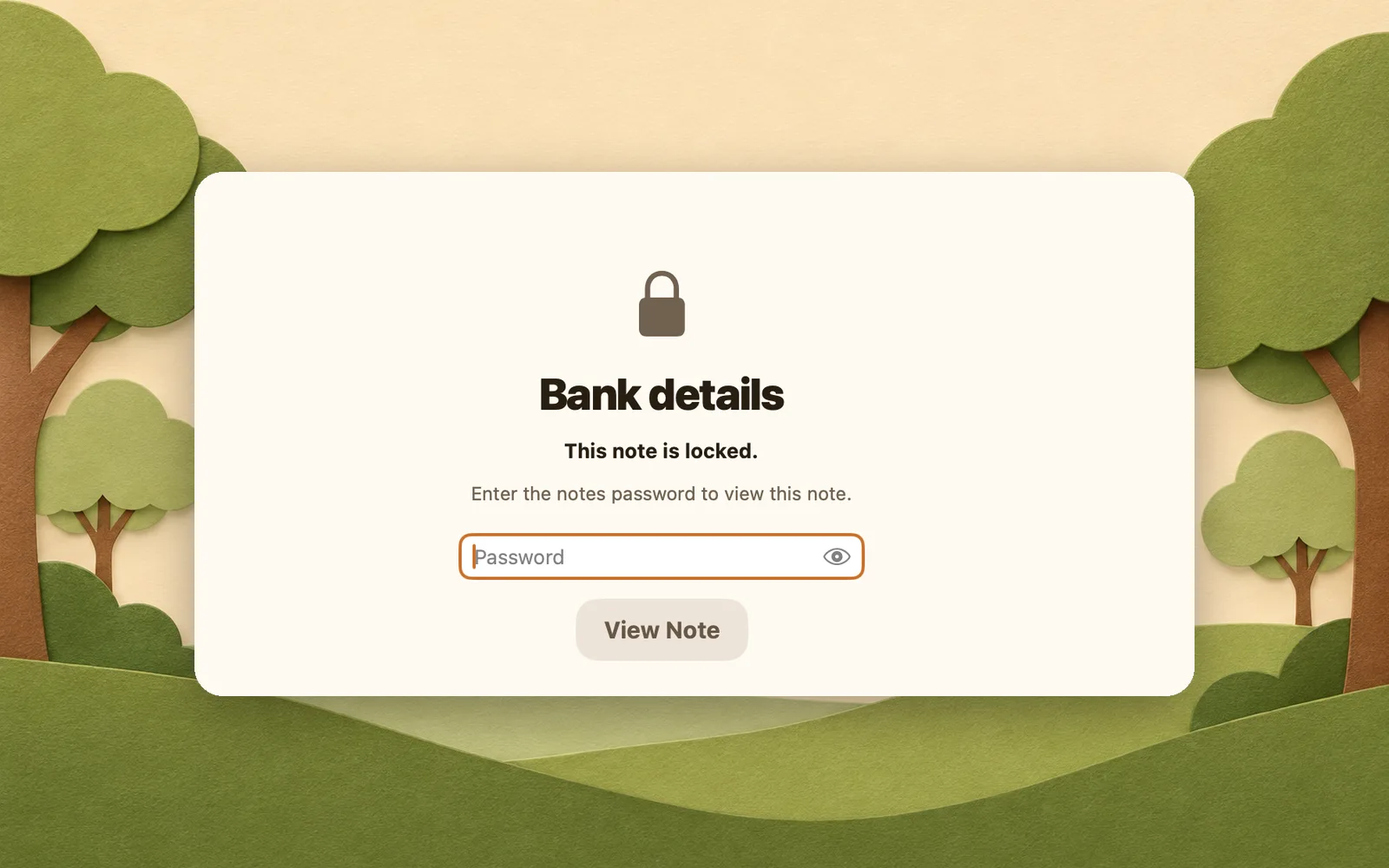
- Locked notes are encrypted a second time, with a key made from your notes password. That key never leaves your devices.
- Signing in, with Apple, Google or a password, says who you are. It is also what lets a new device get your key, with no wait after a password reset. Each time it happens, every device of yours shows “A new device opened your notes” and we email you.
How an AI reads encrypted notes
ChatGPT and Claude run in the cloud, so something has to open your notes for them. Here's how it goes:
- You start connecting from ChatGPT or Claude. A page on pintonotes.com asks you to sign in and shows a two-digit number.
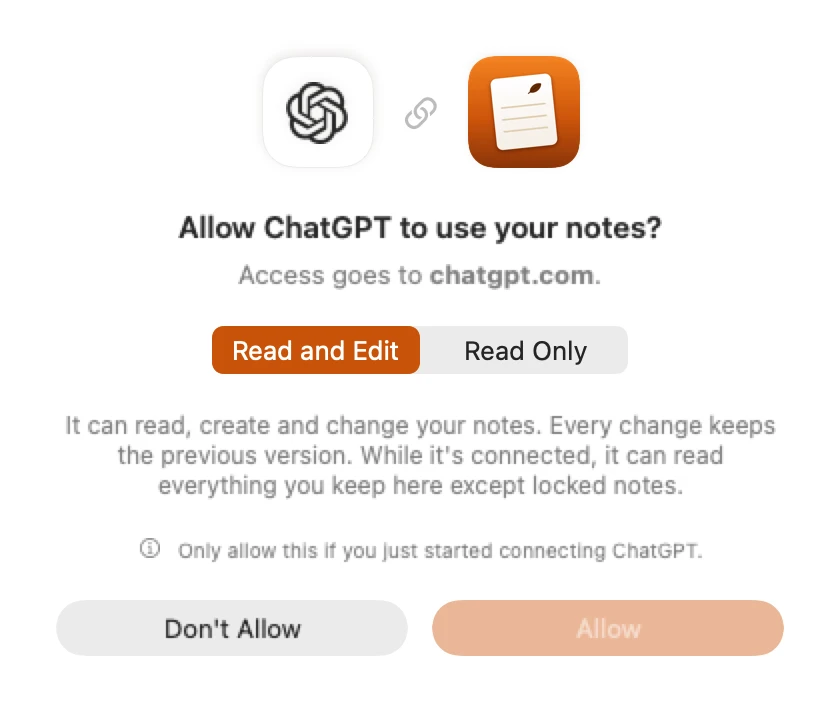
- Pinto Notes on your Mac asks whether to allow it. You type the number, choose Allow, and confirm with Touch ID or your Mac password.
- That connection gets a copy of your notes' key, locked with a key derived from its own access token. We keep only a hash of the token, so the copy stays locked at rest.
- The AI sends its token with each request. During that request, our server uses it to unlock the key in memory, reads the notes it asks for, encrypts any change it makes, and forgets the key when the request ends.
- Disconnect it in Settings, Connect an AI, and its copy of the key is deleted at once.
So the honest version is: we could open your notes if we had to. And while an AI you approved is connected, our server opens the notes it asks for, in memory, to answer it. Locked notes stay out of reach even then; an AI sees only their titles. The consent sheet says so before you allow anything.
The limits

- Our copy of your key. We hold a copy of it, sealed with a secret kept outside the database. We hold both, so we could open your notes, and so could someone who took over our hosting account. The sealed copy can't be opened with a copy of the database alone. A recent copy of the database also holds sign-in sessions, though, and a session from a sign-in in the last hour can get your key as a device of yours would.
- Signing in. Anyone who can sign in as you can open your notes, also right after resetting your password from your mailbox. The notice on your devices and the email tell you it happened. They don't stop it.
- AI requests. While an AI works, our server handles the text it asks for, and our hosts (Vercel and Supabase) carry that text on its way. Neither stores it, but a changed server could copy it. Disconnecting ends this at once.
- The recovery key in the browser. Approving on pintonotes.com with a recovery key runs our code in your browser. It never stores or sends the key, but a changed page could read it. Approve from your iPhone or Mac when you can.
- No key rotation yet. Your notes' key stays the same for the life of your account.
- The database. Someone with only an old copy of it can't read your notes. A recent copy holds sign-in sessions, and one from a sign-in in the last hour can get your key where we keep a copy. Someone running it could roll a note back to an earlier encrypted version, or hide notes from your devices. Where we keep a copy of your key, they could also sign in as you and get it.
- Shared notes. A note you share as a web page is published as a readable copy while it's shared.
Some details also stay readable to us, including:
- your email address and your sign-in records
- your profile name and photo
- your notes-password hint
- the size and dates of each note, file and version
- which folder each note is in, and which notes are sub-notes of which
- which notes are pinned, and which are locked
- the names of the AI apps that edited a note
- your list of devices
The full list, every log and how long each is kept are on Privacy & Security, and the code is open source.
How other notes apps handle it
End-to-end encryption and a cloud AI want opposite things: the first keeps the server blind, and the second needs someone to read the text. Every app picks a side, or finds a way round it on your own computer.
| App | End-to-end encrypted | Can a cloud AI reach it? | How |
|---|---|---|---|
| Pinto Notes | No; we keep a locked copy of your key | Yes, from any device | Built-in MCP server; our server opens the notes an approved AI asks for, during its requests |
| Apple Notes | With Advanced Data Protection turned on; locked notes always | No | No API; Claude's desktop extension and community servers work on your Mac only |
| Standard Notes | Yes, keys from your password | No official way | A community MCP server decrypts on your own computer, for Claude Desktop |
| Notesnook | Yes | No official way | No official MCP server; third-party ones exist, so check how they get your key |
| Obsidian | Files are local; Obsidian Sync is end to end | No official way | Community plugins and servers on your computer |
| Notion | No; encrypted at rest, readable to Notion | Yes | Official hosted MCP server |

If you never want a server to see your text, a local setup is the stricter choice: Standard Notes with a local MCP server, or Obsidian with a plugin, works while that computer is on. If you want ChatGPT on your phone to add to a list while you're out, something in the cloud has to read it, and the question becomes who, when, and whether you can see and end it. Pinto Notes' answer is: only for an AI you approved on your own device, only during its requests, and never for locked notes.
Best AI notes app in 2026 compares how other apps handle AI. Apple Notes has no API, so its AI routes run through a Mac.
In Apple Notes there's no folder lock; you have to lock individual notes.
Try it

Pinto Notes is free and open source. The Mac app is on the download page, and the iPhone app is on the App Store. Import your Apple Notes on the Mac, then connect ChatGPT or Claude. Every change it makes keeps the version before, so you can undo it.
Questions
Is Pinto Notes end-to-end encrypted?
No, unless you turned on Advanced protection before we retired it. Your notes are encrypted on your devices before they sync, and we keep a locked copy of your key so that signing in opens your notes on a new device. That means we could open your notes if we had to, for example under a court order, and so could someone who gets into your account.
If the notes are encrypted, how can ChatGPT read them?
When you approve an AI on your Mac, that connection gets a copy of your notes' key, locked with a key derived from that connection's own access token. We store only a hash of the token, so the copy can't be opened at rest; the AI sends the token with each request, and during that request our server unlocks the key in memory, reads the notes the AI asks for, and forgets the key when the request ends. Disconnecting deletes that copy.
Can an AI read my locked notes?
No. Locked notes are encrypted a second time with a key made from your notes password, which never leaves your devices. An AI sees only their titles.
What can Pinto Notes still see?
Without opening anything, account details and structure: your email address, the size and dates of notes, which folder each note is in, which notes are pinned or locked, your devices and your AI connections. The Privacy & Security page lists everything. We also keep a locked copy of your key, so we could open your notes if we had to.
Can I change my encryption key?
Not yet. Your notes' key stays the same for the life of your account. Disconnecting an AI deletes its copy of the key, but key rotation isn't built yet.
Checked against the app on .