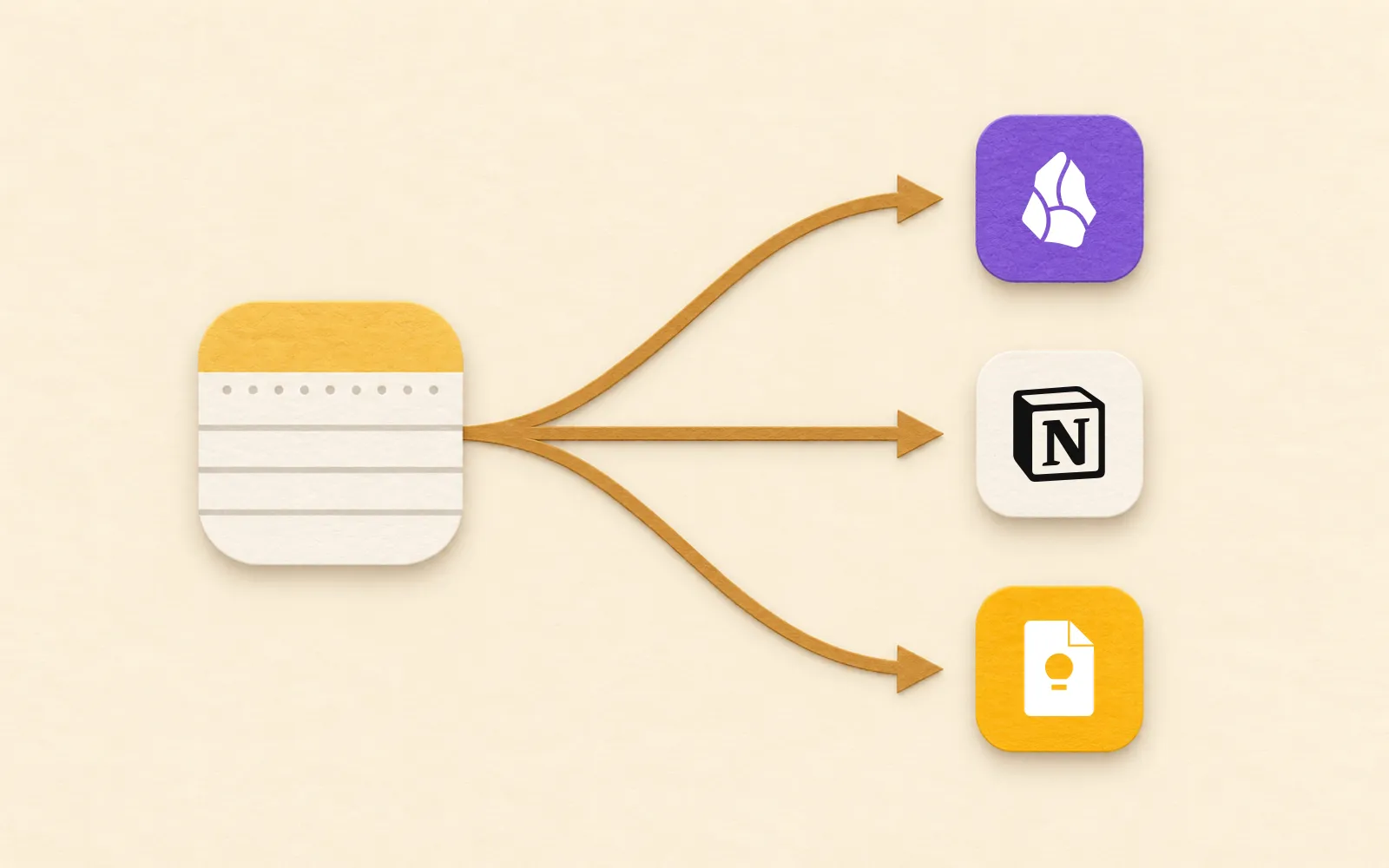
Obsidian alternative for Mac: choosing where to move
Pinto Notes is an Obsidian alternative for Mac if you want Apple Notes' layout and an import for your vault. Choose Bear for Markdown writing organised with tags, Apple Notes for everyday notes, or Joplin for an open source notebook app.

Choose by what you want to change
Start with the part of Obsidian you want to leave. A different editor may be enough. If you want a different way to organise your notes, try it with a small folder first.
- Pinto Notes: Apple Notes' layout, an Obsidian import and connected ChatGPT or Claude access. For iPhone and Mac only.
- Apple Notes: everyday notes with folders, checklists and search. A route to try if you already want to use Apple's app.
- Bear: Markdown writing with tags and tables. Its iCloud sync requires Bear Pro.
- Joplin: an open source app with notebooks and offline Markdown notes. It also runs on Windows, Linux and Android.
Apple Notes can import a folder of Markdown files. On a Mac, choose File, Import Markdown and select the folder. Turn on “Preserve folder structure on import”, under Options if needed. Check pictures and [[links]] yourself. Apple's import guide documents folder import, without promising to reproduce an Obsidian vault. Our Apple Notes vs Obsidian comparison covers the wider differences. Leaving Mem before it closes? The Mem AI alternative guide has its dates and a Markdown import to test.
Bear's import guide has a specific route for Markdown with attachments: File, Import From, Markdown Folder. It reads notes and referenced attachments within that folder and its subfolders. Choose Bear if tags suit your writing.
Joplin suits a notebook library you need on several operating systems. Its desktop app imports a directory through File, Import, MD - Markdown (directory), preserving folders as notebooks and subnotebooks. See its import instructions. You choose a sync service, such as Dropbox or Nextcloud.
When keeping Obsidian makes sense
An Obsidian vault is a local folder of Markdown files. Other editors can change those files, and Obsidian picks up the changes. If that is how you work with scripts or another editor, a replacement that imports copies changes your workflow.
Obsidian also has a graph, Canvas and community plugins. A query generated by a plugin needs more than the Markdown text around it. Keep Obsidian if you rely on those tools, or save the results you need as ordinary note content before moving. These are reasons to choose Obsidian, described on its own feature page.
If AI access is your only reason for leaving, first read the Obsidian MCP guide. You may be able to keep your vault. This guide is for moving the notes into a different app.
Move an Obsidian vault to Pinto Notes
Pinto Notes looks and works like Apple Notes on iPhone and Mac. It keeps every earlier version of a note. It imports your vault into its own library, so subsequent edits in Pinto Notes and Obsidian are separate. There is no Windows, Android or web app.
- Keep a backup of your whole vault folder, including pictures and other attachments.
- On your Mac, open Pinto Notes' File menu and choose Import from Obsidian.
- Pinto Notes finds your vault. Confirm the right folder, or choose another folder.
- Import it, then open a few notes and follow their links before switching your daily work.
Subfolders, pictures and the links between notes come too, and your vault stays where it is. Import your notes describes Pinto's import routes. An embedded note becomes a link to that note. The hidden .obsidian settings folder is skipped. Importing the text does not reproduce your plugin setup or a Canvas workspace.
Once you connect ChatGPT or Claude, it can read and edit the imported notes. Ask it to read a named project note and add a summary under a heading. Check the result in the note. Its earlier version remains in history.
You can export the library as a ZIP of Markdown files in folders, with attachments and links rewritten to point to the exported copies. Open any locked notes first, and check the export report for files that could not be downloaded. Export gives you files to take elsewhere; it does not sync changes back to your original vault.
Check an import before moving everything
Try a folder with a linked pair of notes and a picture. Include a note that depends on a plugin if you use one. Read the imported result beside the original and decide whether it still does the job.
A vault migration checklist
Before moving an Obsidian vault
- Keep a backup of the whole vault, including its attachments and hidden settings folder.
- Open a note with a picture and check that the picture came across.
- Follow a link between notes, including one into a subfolder.
- Check an embedded note and any plugin-generated content.
- Search for a note whose title you remember.
- Try the imported notes on your iPhone if you use one.
- Open an exported Markdown file in another editor before committing to the new app.
Keep your original vault and backup until you have checked the imported library and opened its export. Then choose which app you will write in, so new changes have one place to go.
Questions
Which Mac notes app can import an Obsidian vault?
Pinto Notes imports a vault on a Mac with subfolders, pictures and links between notes. Bear documents a Markdown Folder import with attachments. Joplin imports a Markdown directory into notebooks and subnotebooks. Apple Notes imports Markdown folders too. Check links and attachments in the result before moving everything.
Can I use Pinto Notes to edit my existing vault in Finder?
Pinto Notes imports a copy into its own library and leaves the source vault where it is. It doesn't keep that vault in sync. You can export the Pinto library as Markdown files in a ZIP, but that is a separate export.
What happens to embedded Obsidian notes in Pinto Notes?
Embedded notes become links to those notes. Pictures and other linked files import as attachments. Obsidian's settings folder is skipped, so importing your notes doesn't move your plugin setup with them.
Which Obsidian replacement works on Mac and Android?
Joplin runs on both, supports Markdown notes and offers a choice of sync services. Pinto Notes runs on iPhone and Mac only. If you want to keep editing the same folder of local Markdown files, staying with Obsidian is also an option.
Checked against the app on .